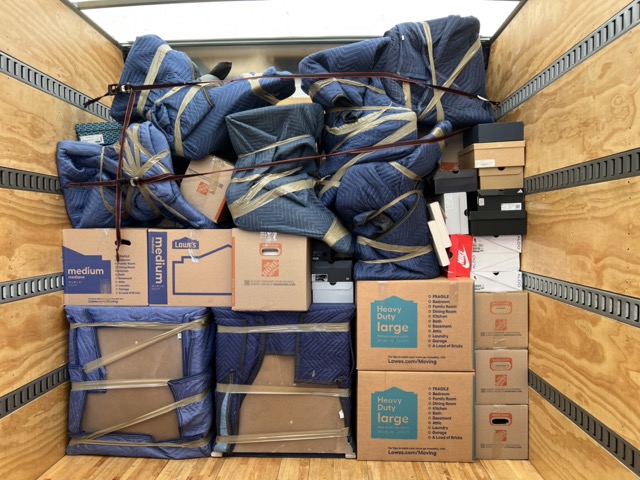
Most household items are surprisingly resilient.
A couch can survive quite a bit. Dining chairs generally don’t panic under pressure. Books are practically immortal unless somebody introduces water into the equation, which, historically speaking, has been a recurring problem for books.
Then there are the other items. The items that cause movers to slow down slightly and stare for a moment. Not because they’re confused. Well, sometimes because they’re confused. Mostly because they understand the consequences of getting it wrong.
A hand-carved antique cabinet. A six-foot mirror. Fine artwork. A marble sculpture. A crystal chandelier that appears to contain approximately seven hundred tiny pieces, each apparently designed by someone who disliked moving companies.
These are the items that enter custom crating territory.
People often imagine it as something reserved for museums, art galleries, wealthy collectors, or perhaps a mysterious billionaire transporting dinosaur bones between private islands.
And yes, museums use custom crates. Art galleries do too. But so do regular homeowners. Quite a few of them, actually. Because the moment an item becomes unusually fragile, unusually valuable, unusually heavy, unusually shaped, or some terrible combination of all four, cardboard begins to lose the argument.
Let’s not be unfair to cardboard. Cardboard is excellent. Entire civilizations of online shopping depend upon it. It serves humanity faithfully every day.
But cardboard has limitations.
Put enough weight into it and those limitations become obvious. Add delicate surfaces, sharp corners, unusual dimensions, or long-distance transportation and things get complicated quickly. Imagine transporting a large framed oil painting across several states. Now imagine protecting it using two moving blankets and confidence. The confidence won’t help. Confidence rarely helps furniture. That’s one of the strange truths people discover during moving.
Custom crating exists because some belongings require protection engineered specifically around their vulnerabilities rather than protection designed for average circumstances.
And valuable items are rarely average. Neither are sentimental items. Which, in many cases, are even more important.
This is where things get interesting. People often focus on financial value. Reasonable enough. A $15,000 sculpture deserves protection. No argument there.
But moving companies quickly learn that monetary value tells only part of the story. Sometimes the most important item in a house is worth very little on paper. A grandfather’s rocking chair, a family heirloom mirror, an old clock that’s been passed through generations, maybe a handmade cabinet built by somebody’s father thirty years ago.
Insurance can replace many things. Sentimental history is considerably harder to order online. That’s why professional crating decisions aren’t based solely on price tags. They’re based on consequences. If this item were damaged, what would that mean? Sometimes the answer is financial. Sometimes the answer is emotional. Both matter.
People usually recognize fragile objects when they see them. Glass. Crystal. Artwork. Simple.
The more interesting challenge involves items that appear strong. Marble seems durable right up until it cracks. Large furniture pieces often look indestructible until structural stress introduces itself. Heavy gym equipment can contain delicate electronic components. High-end audio systems sometimes react poorly to vibration. Antique wood furniture can suffer damage from pressure applied in exactly the wrong location.
Fragility is sneaky. It doesn’t always announce itself. A useful reminder that appearances occasionally lie. Not just in moving. In general.
People assume impact causes most moving damage. Sometimes it does. More often, the problem is movement.
Tiny movement. Repeated movement. The sort of movement nobody notices at first. A slight vibration, a subtle shift, a small amount of pressure repeatedly applied over hundreds of miles.
A properly designed crate eliminates unnecessary movement. The object stays secure, supported, immobilized. No sliding. No shifting. No spending eight hours having an argument with physics.
Physics always wins those arguments anyway. Best not to encourage it.
People occasionally imagine custom crating as a straightforward process. Measure items, build boxes, problem solved.
Reality is a bit more complicated. Professional crating begins with questions. What is the item made of? Where are its weak points? How much does it weigh? How far is it traveling? Will it encounter stairs? Elevators? Long-distance transportation? Temporary storage? Climate changes? Different answers produce different crate designs.
A large mirror requires different protection than a marble statue. A chandelier requires different support than a sculpture. A grandfather clock requires an entirely different strategy because grandfather clocks seem determined to be difficult.
The crate must match the challenge. Not the other way around.
Wood gets all the attention. Wood looks impressive. Foam quietly does much of the work.
A good crate isn’t simply a wooden shell — it’s a complete protection system. Interior cushioning absorbs vibration, specialized supports distribute weight. Protective barriers prevent contact between delicate surfaces and structural components.
The object isn’t merely placed inside the crate — it’s integrated into a carefully designed environment. Almost like creating a temporary home. A very boring but effective one.
Here’s a lesson moving professionals learn early — nothing is truly the size people think it is.
A table always seems smaller before moving day. Sofas mysteriously grow larger. Mattresses acquire additional dimensions through unknown means. And artwork possesses an uncanny ability to become wider the moment somebody approaches a doorway.
Measurements matter because transportation involves more than the object itself. The crate must move through hallways, elevators, loading docks, staircases, trucks, storage facilities, and final destinations. A wonderful crate that doesn’t fit through a doorway becomes a very expensive conversation piece. Nobody wants that.
Careful planning prevents unnecessary surprises. And surprises are generally overrated.
Naturally, some people wonder whether they can build their own crates. The answer is yes.
Sometimes.
Building a wooden box is not particularly difficult — building a transportation-grade protective system is different. The challenge isn’t construction. It’s understanding stress points, support structures, shock absorption, weight distribution, transport conditions, and material behavior.
A crate can appear sturdy while protecting an item poorly. Another crate can appear simple while being remarkably effective. Good engineering often hides itself. People notice it most when it’s absent. Much like good referees, air conditioning, or stable internet connections — nobody talks about them until something goes wrong.
The longer an item travels, the more important protection becomes.
A local move presents one set of challenges. A cross-country relocation presents another entirely. More mileage means more vibration. More handling. More loading and unloading. More opportunities for something unexpected to happen.
Professional crating becomes increasingly valuable as distance increases because the crate acts as a constant layer of protection regardless of what conditions arise during transit. Road quality changes, weather changes, traffic changes — the crate remains the same. Reliable and predictable. Quietly doing its job.
Custom crating isn’t about being overly cautious — it’s about recognizing that certain belongings deserve protection specifically designed around their unique risks.
Some items fit comfortably inside standard boxes. Others don’t. Some possessions can tolerate minor bumps and vibrations. Others cannot. And some objects carry value that extends far beyond money. Those deserve special consideration.
Wood, foam, measurements, engineering calculations, support systems, shock absorption — it all sounds a bit technical. Maybe even boring. Until moving day arrives. Until the truck is unloaded. Until the crate is opened. And the item inside looks exactly the same as it did when the journey began.
Excellence in every move with years of experience in the moving industry
Continue